
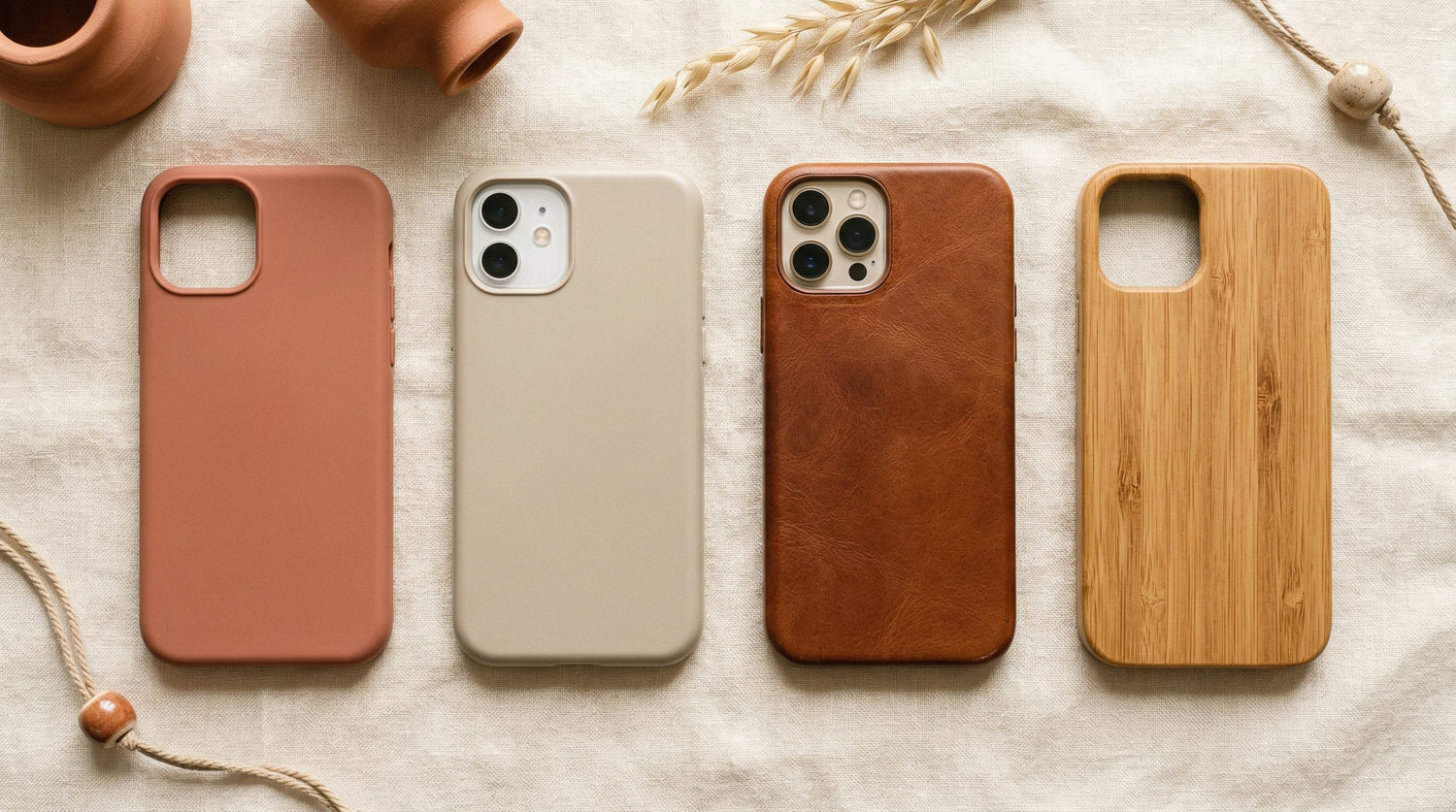
Phone Case Materials Explained: Which One Is Right for You?
Every phone case product page throws around material names like they're self-explanatory. "Premium TPU." "Aircraft-grade polycarbonate." "Liquid silicone." These terms sound impressive, but most people have no idea what they actually mean for the case sitting in their hand — how it feels, how long it lasts, what it protects against, and what it quietly fails at.
This guide explains each material in plain language. What it is, where it's strong, where it's weak, and which type of person it suits best. No sales pitch — just material science made practical.
Polycarbonate (PC): The Hard Shell
What It Is
Polycarbonate is a thermoplastic polymer — a rigid, transparent plastic with impressive impact resistance relative to its weight. It's the same family of material used in safety goggles, aircraft windows, and bullet-resistant glass (in layered form). In phone cases, PC forms the hard outer shell that gives the case its structure.
How It Performs
Polycarbonate is excellent at resisting scratches, maintaining shape, and distributing impact force across a wide area instead of concentrating it at the point of contact. A PC case won't deform in your pocket, won't stretch out over time, and won't show scratch marks from keys and coins as quickly as softer materials.
It's also lightweight. A polycarbonate case adds minimal bulk — typically less than 15 grams — which matters when you're holding a phone that already weighs 200+ grams.
The Weak Points
Pure polycarbonate is slippery. Without texture or coating, a PC case feels like holding a smooth plastic box — not great for grip. PC also lacks flexibility, which means it can crack under extreme point impacts (a corner hitting concrete at high speed) rather than absorbing the force. This is why PC cases almost always pair with a softer material at the edges.
UV exposure also degrades polycarbonate over extended periods, causing slight yellowing and brittleness — though this takes much longer than with TPU.
Best For
People who want a slim, lightweight case with a hard feel. Works well as the structural backbone of hybrid cases.
TPU (Thermoplastic Polyurethane): The Shock Absorber
What It Is
TPU is a flexible, rubber-like material that combines the elasticity of rubber with the durability of plastic. It's widely used in phone cases, shoe soles, watch bands, and medical devices. The "thermoplastic" part means it can be melted and remoulded, which makes it ideal for manufacturing — but it also means it's susceptible to UV degradation.
How It Performs
TPU is the primary shock-absorbing material in phone cases. When your phone hits the ground, the TPU flexes and compresses, absorbing kinetic energy and distributing it across a larger area. This is the crumple zone principle — the same concept used in car bumpers, just scaled down. A good TPU case can reduce the peak impact force reaching your phone by 50-70%, depending on thickness and design.
TPU also provides natural grip. Its slight tackiness prevents the case from sliding off surfaces and gives you a more secure hold. This is particularly noticeable compared to polycarbonate or glass — TPU feels "sticky" in a good way.
The Weak Points
TPU's biggest enemy is ultraviolet light. Exposure to sunlight causes a chemical reaction that turns clear TPU yellow — a process that's impossible to reverse and inevitable over time. Anti-yellowing coatings slow this process (from 2-3 months to 6-12 months) but don't prevent it entirely.
TPU is also too flexible to provide structural protection on its own. A TPU-only case will absorb a drop's energy well, but it won't prevent the phone from bending under sustained pressure (like sitting in a tight back pocket). Finally, TPU attracts fingerprints and can develop a slightly oily sheen over time.
Best For
People who prioritise drop protection and grip. Ideal as the inner layer in hybrid cases or as the primary material in slim bumper cases.
Silicone: The Comfortable Choice
What It Is
Liquid silicone rubber (LSR) is a synthetic rubber with a distinctively smooth, matte texture. It's the material Apple used for its popular (now discontinued) silicone case line. Silicone is made from silica (sand), oxygen, carbon, and hydrogen — making it one of the more chemically stable materials used in phone cases.
How It Performs
Silicone provides moderate shock absorption — not as effective as TPU in extreme drops, but sufficient for everyday use. Where silicone genuinely excels is in-hand feel. The velvety, matte finish is what most people describe as "premium" when they pick up a silicone case. It doesn't attract fingerprints the way TPU does, and its natural hydrophobic properties make it resistant to water and sweat.
Silicone is also hypoallergenic and naturally resistant to bacterial growth, which is a genuine (if underappreciated) advantage for something you touch hundreds of times daily.
The Weak Points
Silicone is a lint and dust magnet. The same soft surface that feels great in your hand attracts every fibre in your pocket. It's also softer than TPU, which means it tears more easily at thin stress points like the charging port and button cutouts.
Durability is the main concern. A silicone case that feels premium on day one can develop visible wear — stretched edges, small tears, surface marks — within 4-6 months of daily use. Silicone also stains more easily than harder materials; a splash of turmeric on a light-coloured silicone case is effectively permanent.
Best For
People who value in-hand feel above all else. If you take good care of your accessories and replace cases periodically, silicone delivers a tactile experience that other materials can't match.
Hybrid Construction (PC + TPU): The Practical Choice
What It Is
Not a single material, but a design approach that combines polycarbonate and TPU in a layered structure. Typically: a rigid PC back plate provides structure, scratch resistance, and the surface for printed designs, while a flexible TPU frame wraps around the edges for shock absorption and grip.
How It Performs
Hybrid cases are the most common design in quality phone cases for a reason — they address each material's weaknesses with the other's strengths. The PC back resists scratches and maintains a clean surface for artwork or photography. The TPU bumper absorbs drops and provides the flexibility needed to snap the case on and off without cracking.
Many hybrid cases also incorporate air-cushion technology at the corners — small hollow chambers in the TPU that compress on impact, providing additional shock absorption at the phone's most vulnerable points. Macmerise's FOMO Plus uses this approach with reinforced TPU corners and a polycarbonate body.
The Weak Points
Hybrid cases involve a seam between the PC and TPU components. In lower-quality cases, this seam can separate over time, especially if you frequently remove and reapply the case. Quality construction methods (overmoulding, where TPU is moulded directly onto the PC) eliminate this risk but add to the manufacturing cost.
Best For
Most people. Hybrid cases offer the best balance of protection, aesthetics, grip, and durability. If you're unsure which material to choose, a well-made hybrid case is the default recommendation.
Tempered Glass: The Premium Option
What It Is
Some cases use tempered glass on the back panel — the same type of strengthened glass used on phone screens. The glass is heated to around 620°C and then rapidly cooled, creating a surface that is 4-5 times stronger than regular glass. The edges are typically reinforced with a TPU or metal bumper.
How It Performs
Glass-backed cases have a smooth, cool feel that's distinct from any plastic. They're extremely scratch-resistant (harder than polycarbonate on the Mohs scale) and maintain their clarity and surface quality indefinitely — no yellowing, no fingerprint buildup, no surface wear.
Glass also doesn't interfere with wireless charging or NFC the way thick plastics can. If you use MagSafe or Qi charging regularly, a glass-backed case can deliver slightly better charging efficiency than thick plastic alternatives.
The Weak Points
Glass breaks. This is the fundamental contradiction of a glass phone case — it's protecting your phone with a material that shares your phone's primary vulnerability. A glass-backed case dropped on concrete can shatter, leaving you with two cracked glass surfaces instead of one.
Glass is also heavier than polycarbonate or TPU. A glass-backed case adds noticeable weight, which some people find tiring during extended use. And while glass is scratch-resistant, it shows fingerprints and smudges more than matte-finished materials.
Best For
Careful users who rarely drop their phone and want the smoothest look and feel. Also worth considering if wireless charging efficiency matters to you.
MagSafe Ring Materials
MagSafe-compatible cases include a ring of magnets embedded in or adhered to the case. These are typically neodymium (NdFeB) magnets — the strongest type of permanent magnets available commercially. The grade matters: N52 magnets (the highest grade) provide the strongest hold, while cheaper cases use N35 or N42 magnets that offer noticeably weaker attachment.
The magnets are usually embedded in a steel or iron ring that provides additional magnetic attraction and proper alignment with Apple's MagSafe specifications. Higher-quality cases integrate the magnets flush with the case surface; budget cases sometimes have a visible or palpable bump where the magnet ring sits.
Drop Test Standards: What MIL-STD-810G Actually Means
You'll see "MIL-STD-810G tested" on many case product pages. MIL-STD-810G is a United States military standard that defines environmental testing conditions for equipment. It covers temperature, humidity, vibration, altitude, and — relevant to phone cases — shock/drop testing.
The drop test protocol involves 26 drops from 122cm (about waist height) onto a 2-inch plywood surface over concrete. The device must remain functional after all 26 drops. Important caveats: the standard doesn't require zero cosmetic damage, and "functional" means "turns on and works" rather than "looks perfect." A case can pass MIL-STD-810G while allowing dents, scratches, and even minor cracks — as long as the phone still functions.
Also worth noting: there's no independent certification body for MIL-STD-810G. Brands self-certify by conducting (or commissioning) the tests and reporting results. This doesn't mean the claims are false, but it does mean there's no third-party verification — unlike, say, IP68 water resistance ratings which have standardised testing by accredited labs.
How to Clean and Maintain Different Materials
| Material | Cleaning Method | Avoid | Maintenance Tip |
|---|---|---|---|
| Polycarbonate | Damp cloth, mild soap | Abrasive cleaners, acetone | Use a microfibre cloth to avoid fine scratches |
| TPU | Warm water and dish soap | Alcohol-based cleaners (accelerate yellowing) | Remove case weekly to clean trapped dust underneath |
| Silicone | Warm soapy water, air dry | Oil-based cleaners, harsh solvents | Use a lint roller to remove dust and fibres regularly |
| Glass | Glass cleaner or isopropyl alcohol | Abrasive pads | Wipe daily to keep fingerprint-free appearance |
One universal tip: remove your case every couple of weeks and clean both the inside of the case and the back of your phone. Dust and tiny particles trapped between the case and phone act like sandpaper, creating micro-scratches on the phone's surface over time. It takes thirty seconds and saves your phone's resale value.
Frequently Asked Questions
Which material provides the best drop protection?
Hybrid cases (PC + TPU) consistently perform best in drop tests because they combine structural rigidity with shock absorption. TPU handles the energy absorption, PC maintains the case's shape and prevents it from deforming. Cases with air-cushion corners in the TPU add another layer of protection. For maximum drop protection, look for hybrid cases with corner reinforcement — the corners are where most drop energy concentrates.
Why do clear cases turn yellow and can it be prevented?
Clear cases yellow because UV light causes a chemical reaction in TPU called photo-oxidation. The polymer chains break down and form chromophores — molecules that absorb blue light and appear yellow. Anti-yellowing coatings (UV stabilisers) slow this reaction significantly, extending clear appearance from 2-3 months to 6-12 months. But no currently available treatment prevents it indefinitely. If staying clear matters to you, budget for a replacement every 8-12 months.
Is silicone or TPU better for everyday use?
For pure protection, TPU wins. It's more durable, provides better shock absorption, and lasts longer before showing wear. For in-hand comfort and feel, silicone wins. It has a softer, more premium texture that many people prefer. If you had to choose just one, TPU is the more practical choice for most lifestyles — it's the material you don't have to think about. If you're gentle with your accessories and prioritise tactile experience, silicone is worth the shorter lifespan.
Do case materials affect wireless charging speed?
Yes, to varying degrees. All materials create some distance between the phone's charging coil and the charger, reducing efficiency. Thinner materials and materials with high electromagnetic transparency (glass, thin PC) have minimal impact — typically less than 5% reduction in charging speed. Thick TPU and cases with metal components (non-MagSafe metal plates, metal kickstands) can reduce charging speed by 10-20% or block it entirely. MagSafe alignment helps by ensuring optimal coil-to-coil positioning, partially compensating for material thickness.


Leave a comment
This site is protected by hCaptcha and the hCaptcha Privacy Policy and Terms of Service apply.